
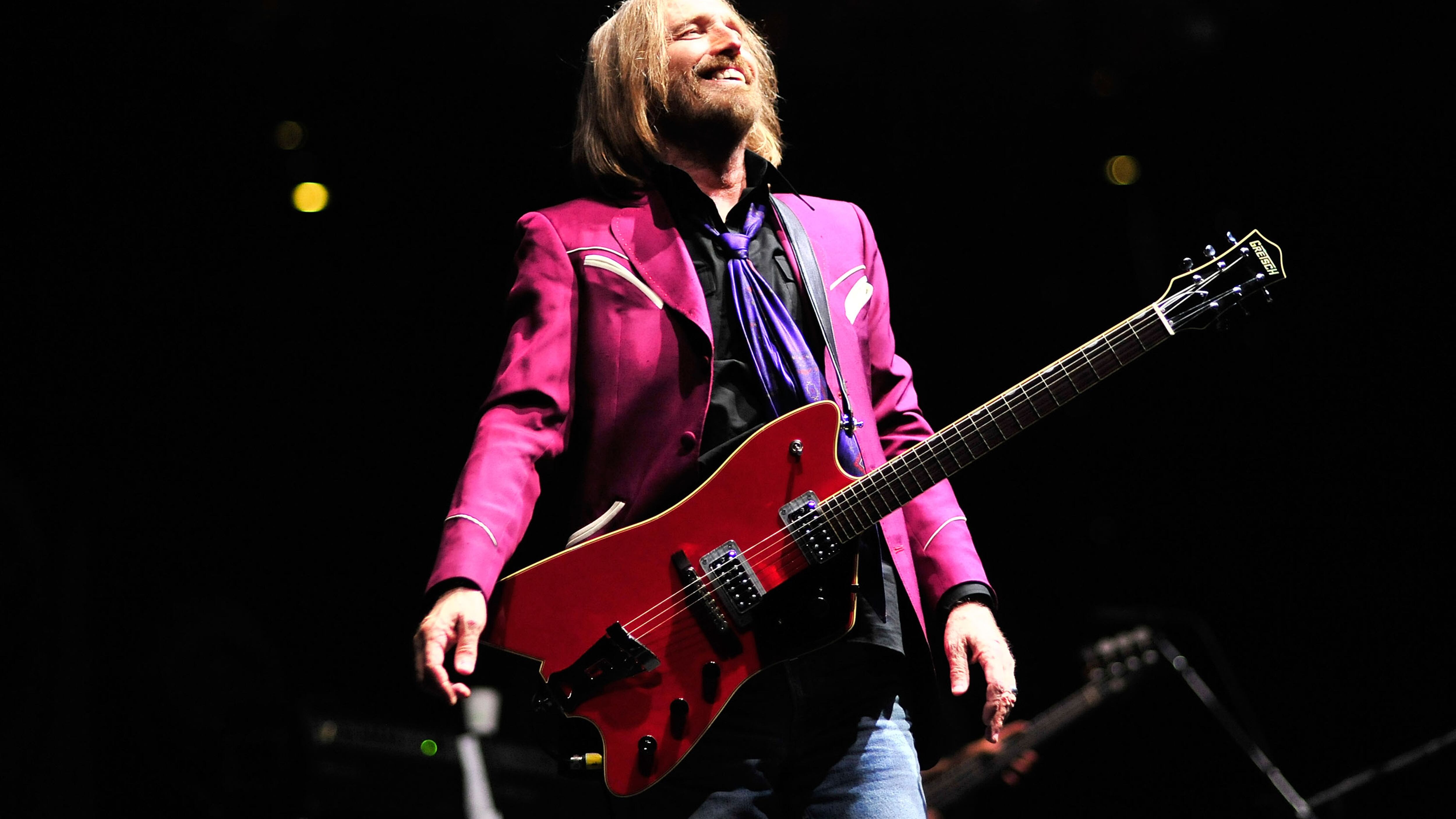
Driving back to Toccoa recently from a day of work in Dahlonega seemed pretty routine: a warm Monday afternoon (Oct. 2), the windows were down a bit in my 1992 Honda Accord, and the radio was tuned to 97.1 FM, The River—Atlanta’s “classic rock” station. Between songs, seemingly out of nowhere, deejay Kaedy Kiely issued a report: Tom Petty had suffered cardiac arrest the night before and was currently on life support in a California hospital. She qualified the report by saying her only source was TMZ. She explained to listeners how she knew this Website was known for its tabloid content, but she also knew they were often the first to report celebrity news—that turned out to be accurate. (Based in the Hollywood/Los Angeles area, TMZ stands for “Thirty Mile Zone,” the slice of land that covers Tinsel Town and its surrounds.)
Still zipping along in my Accord, after another song or two, I then hear Kiely’s voice again. She is crying. Not weeping, but choked up, and her tears are being broadcast live. She reported that CBS News had confirmed Petty’s death. Kaedy Kiely was well aware of the horrific tragedy the night before in Las Vegas and maybe as the reliably upbeat, steady voice of this Atlanta rock station—one who often leads charity fundraisers and shares snippets from her interviews with well-known rockers—she had simply reached her breaking point. As it turned out, CBS News was not the confirmation source Kiely assumed they would be: Petty, 66, was still clinging to life, but would indeed pass on later in the evening.
Living in Toccoa for the past 15 years with my wife is a simple fact of life, just like my being born in Gainesville, Florida, a town viewed by many in the Peach State as the Land of the Enemy. Tom Petty, 16-plus years my senior, was also born in the land of Gatorade, but before Gatorade was created, and he wound up quitting Gainesville High School (GHS) at age seventeen, the same school I graduated from in 1985. By that time, a 34-year-old Petty was at the peak of his powers, having released six albums and having written many of his hits that are still appreciated to this day. In the early to mid-1980s, when I worked at GHS's newspaper—The Hurricane Herald—me and my comrades attempted to locate one of those yearbooks from the 1960s that would have included Tom Petty's class photo. No such luck. Either the pilferers or the well-intentioned archivists beat us to the punch.
I never really followed Petty's career past the early 1990s, though I knew he was still at it, recording and touring. Of course, any classic rock station worth its salt has numerous Petty compositions in their play list inventory. Just last year, my sister Amy, who lives in Huntsville, Alabama, was trying to enlist me to see Petty perform with Mudcrutch, one of his early bands from Gainesville; in fact, the same band that headed west to Los Angeles in 1974 to pursue their rock and roll dreams. When Mudcrutch reunited in 2008, they apparently had so much fun that, by 2016, they decided to give it another go. Unfortunately, I declined my sister's offer of a concert rendezvous, citing budgetary reasons. We could not have known that just over a year and a half later, he would be gone. The same year his old band Mudcrutch first reunited was also the year Tom Petty and the Heartbreakers performed at the Super Bowl halftime: In 2008, a huge crowd in Phoenix, Arizona, and millions of people around the world witnessed Petty and the Heartbreakers on their television screens as they belted out "American Girl," a song from the band's 1976 debut album, along with a trio of hits from their lead singer's solo album of 1989, Full Moon Fever—"I Won't Back Down," 'Free Fallin'," and "Runnin' Down a Dream."
This same sister of mine who was hankering to see Petty in concert had recently experienced a Tom Petty renaissance largely because of the new satellite radio show the singer hosted. She enthusiastically shared over the phone her recent discoveries—his songs from more recent decades and the stories he'd spin about his musical influences and musical past. For a birthday gift last year, my sister gave me Warren Zanes' new book, Petty: The Biography. I soon discovered there weren't too many books on Petty and that this book was definitely the authoritative one: Petty was not only interviewed extensively, but suggested the book idea in the first place. This is a strange story. Zanes, who's taught college and was once was a rock and roller in a band like Petty (in fact, in the mid-1980s, his band the Del Fuegos, opened for Petty) penned a book in 2003 about the late singer, Dusty Springfield. Petty read Zanes' book on Springfield—Dusty in Memphis— and was so impressed by it that he contacted his old acquaintance; and not long afterward, a Petty biography was underway with Zanes at the helm.
I read through Zanes’ book in short order, and it made sense when he argued that as much as Tom Petty has been a fixture in Los Angeles since his move there in the mid-1970s, he is most certainly a product of that small, college town of Gainesville, Florida, where he lived until his mid-20s, practicing and playing gigs since the age of 14. To read about your hometown in a book is a bit odd, but Zanes describes it well. Thankfully, he also humanizes the rock legend in a number of ways throughout the book’s pages. For example, in the opening pages of the book we learn that by the late-1990s, as a man well into his 40s, the singer-songwriter had picked up a heroin habit that the general public—and even those close to Petty—were unaware of. As a reader, at first, I was operating on stereotypes related to certain decades, thinking Zanes’ chronology must’ve been off; isn’t that what a rock and roller would’ve suffered from in the 1960s or 1970s? He kicked that 1990s habit with the help of others and carried on after the pain of a divorce from his first wife. But what stood out most to me in this rich biography was an overwhelming snapshot, capturing the curse of fame. Zanes vividly recreates the scene of a 29-year-old Petty, between stops on a 1980 tour, visiting his dying mother, in her 50s, in a hospital room:
"Kitty Petty was all but gone from this world, little more than a body. But that wasn't what Petty saw first. Arriving in her room, looking at his mother, Petty saw himself. Several of himself. 'Someone had laid all these magazines with pictures of me on my mother,' remembers Petty. 'On her chest and across her body. She was just lying there, beneath these clippings from magazines and newspapers. I walk in and…it was the strangest thing. I thought, 'Even in this moment, even this someone had to corrupt with some reaction to fame, or whatever this was.' A nurse had gotten it into her mind that this would please the famous son of the hospital's dying patient. It was a misguided gesture, innocent but stupid, that left him hollow. Asking a nurse to clear the clippings off his mother, he then took time alone with her. 'I was just beginning to see that there's just nobody that couldn't be affected by fame in some way,' Petty explains, 'like when I walk in some place and my music is playing, because they think I want to hear that. I was starting to see that that's just part of the job. But I wasn't prepared for that in my mother's hospital room, you know? I needed to clear the room of that. I looked at her, and I talked to her. She couldn't talk to me. But she had a kind of look in her eyes. It was really hard. I left there thinking, 'I don't ever want to see this again. I don't ever want to see her like this again. That's it for me. She's gone.'"
Some six years after his mother's passing, Tom Petty and the Heartbreakers found themselves employed as Bob Dylan's touring band. Journalist Bill DeYoung of The Gainesville Sun caught up with Petty in a New York City hotel room in the summer of 1986. Among Dylan's songs that night in the Big Apple was "In the Garden," a song off the singer's controversial 1980 gospel album Saved. DeYoung wasn't impressed with Dylan's onstage foray into Jesus territory, thinking the energy level of the show subsequently took a plunge. But Petty, whose mother taught Sunday school in a Baptist church, defended his musical boss: "He [Dylan] had something to say at that point. This ain't show business, man. This ain't show business. That's Bob Dylan. He had something to say at that point. He had something to say about Jesus right then. He [already] sang 'Like a Rolling Stone,' right? He'd already done that. Listen, man, you gotta dig that there's a lot of great songs about Jesus. David Lee Roth [of Van Halen] might not want to do that. But I admire a man that's confident enough in himself to do that. And I tell you what, nobody left."
When it comes to the musical genre of rock, no one’s leaving Tom Petty behind any time soon, if ever. Good rock and roll tends to transcend geography, whether it’s somewhere out of the country—or Toccoa or Atlanta—or New York City or Los Angeles—or Gainesville, Florida. And Tom Petty remembered his roots. A 10-year-old Petty shook hands with Elvis Presley at a film shoot; when he was 13, Petty sat spellbound in front of the television as the Beatles performed on the Ed Sullivan Show. With that said, just days before his untimely death, a 66-year-old Petty told an interviewer that he looked forward to spending more time with his 4-year-old granddaughter; he didn’t see himself crisscrossing the country anymore on those long tours.
After hearing word of Petty's passing, Bob Dylan gave this statement to Rolling Stone magazine: "It's shocking, crushing news. I thought the world of Tom. He was a great performer, full of the light, a friend, and I'll never forget him."
In the Petty biography by Zanes, his last chapter—entitled “Somewhere Under Heaven” (named after a Petty song)—included these words: “Surrounded by his family, he’s got a little more quiet around him. But sometimes, when the house is dark and the others are sleeping, he goes out to the studio, turns on some lights, and looks to see what might come.”
Though several mega hits emerged from Petty's Full Moon Fever album of 1989, there's one little tune, "Alright for Now," that was just too tender, too good for the noisiness of a Super Bowl. Perhaps its opening stanza reflects the spirit of one of Petty's sleepless, late-night, home studio visits: "Goodnight baby, sleep tight my love / May God watch over you from above / Tomorrow I'm workin' what would I do / I'd be lost and lonely if not for you."
There are some things that not even the Super Bowl or TMZ can touch. I’ll never forget that Monday afternoon drive back from Dahlonega, fueled by deejay Kaedy Kiely’s tears.
In the late 1980s, when Bob Dylan, Tom Petty, Roy Orbison, George Harrison, and Jeff Lynne were making a little history with their Traveling Wilburys band, Dylan composed “Shooting Star” on his own, a tune that includes this line: “It’s the last temptation, the last account / The last time you might hear the sermon on the mount / The last radio is playing.”
Last night (Oct. 21) in a concert in Broomfield, Colorado, 76-year-old Bob Dylan surprised his audience by covering Petty’s “Learning to Fly.” The final song of the night’s encore, it was a passionate performance, honoring his old friend and bandmate.
Petty leaves behind his wife of 16 years, Dana, a 24-year-old stepson Dylan; his former wife of 22 years, Jane, and their two daughters, Adria, 42, and Annakim, 35.
###
Scott M. Marshall lives with his wife Amy in Toccoa, Georgia, and teaches at the University of North Georgia in Dahlonega. He is the author of Bob Dylan: A Spiritual Life (Los Angeles: BP Books, 2017)